

Some firearms become collectible because they are scarce. Others earn that distinction through craftsmanship, history, condition, or the simple fact that they have survived decades, sometimes centuries, remarkably complete.
Then there are firearms that combine several of those qualities at once.
The October Collection brings together an extraordinary range of arms spanning nearly 140 years of gunmaking. From a cased Purdey percussion gun built in Victorian London to an elaborate Colt Python presentation created at the end of the 1980s, these four selections could hardly be more different.
One represents the traditions of one of England’s great gunmakers. Another reveals the surprisingly lavish side of early Savage production. A Belgian target pistol turns precision shooting equipment into an exercise in fine art. Finally, a pair of Colt Pythons transforms the Snake Gun concept into an unmistakable late-20th-century presentation piece.
Different countries. Different eras. Different purposes.
What connects them is simple: none was ordinary from the beginning.
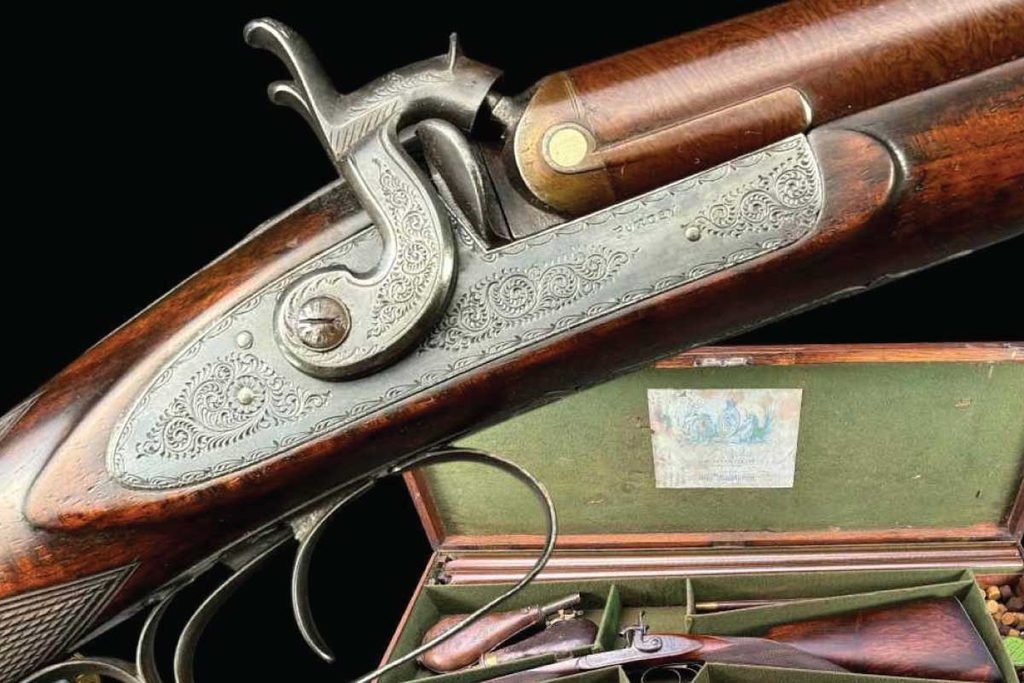
London, 1851: A Purdey That Survived
In 1851, James Purdey was already decades into establishing a name that would become synonymous with fine London gunmaking.
That year is particularly interesting in Purdey history. The company was operating from 314½ Oxford Street, the address it had used since 1827, and James Purdey the Younger was working alongside his father. It was a period of transition and innovation, but the sporting gun was still firmly rooted in the percussion era.
This 12-bore double-barrel percussion game gun, serial number 4839, survives from that moment.
Its age alone would make it worthy of attention. Its survival as a matching, cased example makes the story considerably more compelling.
Built with 29.5-inch Damascus barrels, the Purdey uses a traditional side-by-side percussion muzzleloading configuration with external hammers and double triggers. Fine scroll engraving decorates the locks and metalwork, while the concave rib carries a gold front bead and the period address marking, “JAMES PURDEY, 314 1/2 OXFORD STREET, LONDON.”
Approximately 175 years later, the gun remains in its original configuration with matching serial numbers. The locks remain mechanically sound, the barrels lock tightly to the action, and even the ebony ramrod remains with the gun.
Then there is the case.
The Purdey survives in its original oak case with green interior and a Purdey trade label inside the lid. For a sporting arm produced in the middle of the 19th century, those details help preserve more than the firearm itself. They preserve something of the way the gun was originally presented and carried.
It is a survivor from an entirely different era of sporting gunmaking, when a fine London gun was created by craftsmen working largely by hand and intended to serve its owner for generations.
Nearly two centuries later, this one is still telling that story.
Explore the 1851 James Purdey Percussion Game Gun, GunBroker Item #1207010373.
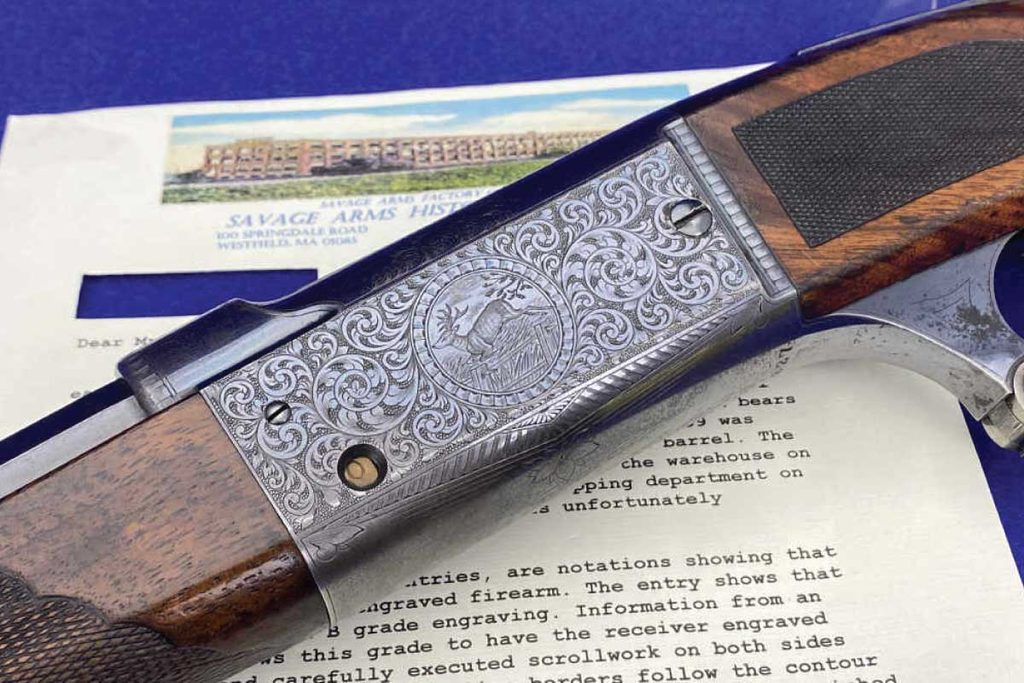
The Other Side of Savage: A Special-Order Model 1899
Mention an early Savage Model 1899 and most collectors picture the innovative hammerless lever-action rifle that helped establish Savage as a major American arms maker.
Serial number 38827 shows just how elaborate an 1899 could become when something more was ordered.
Manufactured in 1906 and chambered in .303 Savage, this special-order rifle features a 26-inch octagon barrel, fancy American walnut, extensive hand-cut checkering, decorative stock treatment, a Lyman tang aperture sight, and factory B Grade engraving.
The receiver is covered with elaborate scrollwork, line borders, floral elements, and game-scene panels. Deer appear within the engraved scenes, surrounded by dense ornamentation that transforms the familiar lever-action rifle into something much closer to a bespoke sporting arm.
Most importantly, the embellishment is not merely assumed to be factory work.
A surviving Savage historical letter documents the rifle as factory engraved and identifies the work as B Grade. That documentation gives collectors something especially valuable when evaluating an embellished antique firearm: a direct connection between the decoration visible today and the configuration recorded by the manufacturer.
The rifle also comes from the celebrated early period of engraved Savage Model 1899 production associated with Enoch Tue. Rather than attributing this particular rifle to an individual engraver without documentation, its 1906 date places it within an important era when Savage was offering remarkably elaborate versions of the Model 1899.
The result is a fascinating counterpoint to the company’s more familiar sporting rifles.
Savage could build practical rifles.
It could also build something like this.
Explore the 1906 Savage Model 1899 B Grade, GunBroker Item #1208981027.
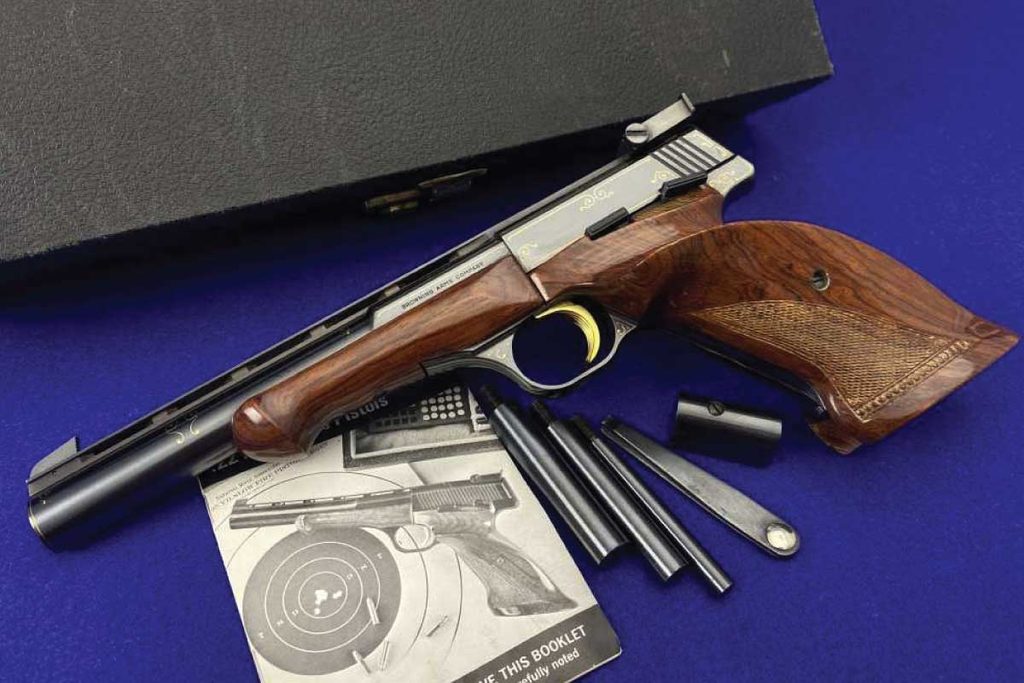
Belgian Precision in Gold: The Browning Medalist Gold Line
By the 1960s, the idea of an extraordinary firearm looked very different.
Fabrique Nationale’s Browning Medalist was conceived as a premium .22 LR target pistol, with the accuracy, balance, sights, and adjustability expected of a serious precision handgun. The Gold Line took that foundation and pushed it into another category entirely.
This example, serial number 86648T7, dates to 1967 and is one of only 407 Medalist Gold Line pistols manufactured.
Against its high-polish Royal Blue finish, factory-executed 24K gold wire scrollwork traces the contours of the pistol. Gold accents appear across the slide, receiver, trigger guard, front strap, and barrel, complemented by a gold-plated trigger.
The result is striking, but the embellishment never obscures what the Medalist was built to do.
A 6.75-inch tapered heavy target barrel, ventilated sight rib, undercut front blade, micro-adjustable rear sight, adjustable single-action trigger, and specialized dry-fire mechanism all reflect a pistol designed around precision shooting. Select French walnut target stocks with a pronounced right-hand thumb rest and matching forend complete the package.
Then, once again, completeness adds another dimension to the story.
This Gold Line retains its original red-velvet-lined Browning presentation case along with the instruction booklet, complete four-piece barrel weight set, weight adapter, shell deflector, mounting tool, ammunition tray, and factory magazine.
With only 407 produced, the Gold Line is scarce in any form. Finding an example accompanied by the components that helped define the original Medalist package allows the pistol to be appreciated much as Browning intended.
It is simultaneously a precision instrument and a display piece, two identities brought together in one of the most distinctive interpretations of the Belgian Medalist.
Explore the 1967 Browning Medalist Gold Line, GunBroker Item #1205408593.
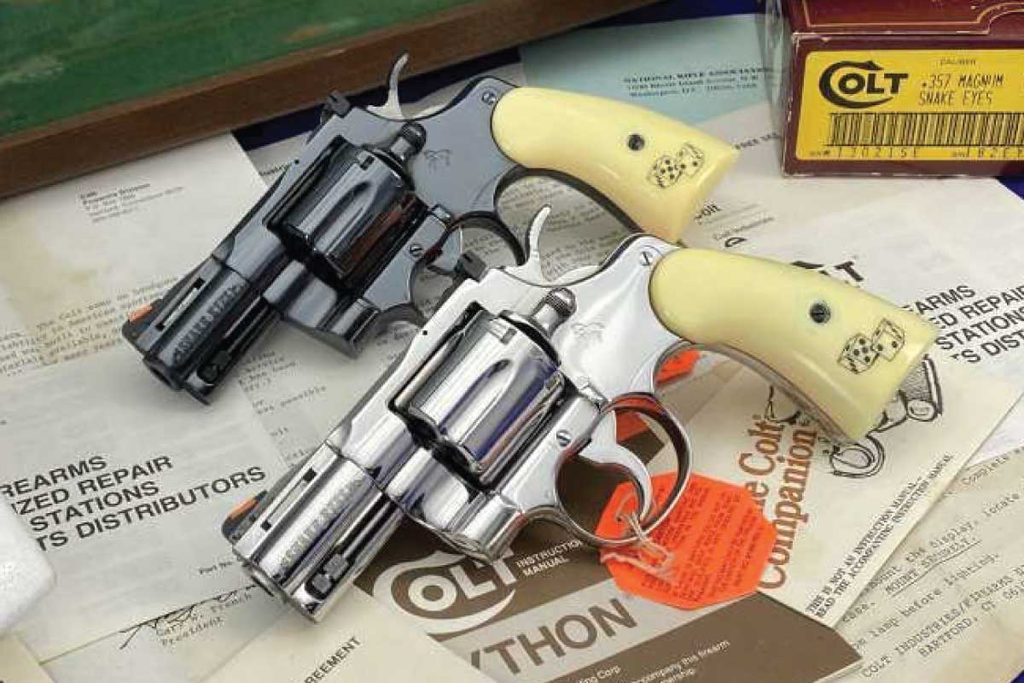
Against the Odds: Colt Python Snake Eyes Set #182
If the Purdey represents Victorian tradition and the Browning blends target engineering with Belgian artistry, Colt’s Snake Eyes set comes from an entirely different school of presentation.
Subtle, it is not.
Introduced in 1989, the Snake Eyes paired two 2.5-inch Colt Python revolvers chambered in .357 Magnum. Only 500 matched sets were produced, for a total of 1,000 revolvers.
This is Set #182 of 500, represented by the complementary serial numbers 182EYES and EYES182.
One Python wears Colt’s Ultimate Bright Stainless finish. Its partner is finished in Royal Blue. Both carry the distinctive “SNAKE EYES” barrel marking and ivory-like grips decorated with gambling-themed scrimshaw imagery, including Snake Eyes dice and a Royal Flush.
The serial numbers themselves were part of the concept. Colt paired each set using the EYES-number and number-EYES format, making the revolvers unmistakable mates rather than simply two similar Pythons. GunBroker’s own coverage of previous Snake Eyes sets confirms the 500-set production and this unusual serial-number arrangement.
But the revolvers are only part of the presentation.
The pair is displayed inside a large furniture-grade walnut cabinet measuring approximately 23.5 inches wide and 17.75 inches high. Interior lighting illuminates the revolvers along with casino-style playing cards, chips, and other Snake Eyes and Colt-themed presentation pieces.
That cabinet matters.
Complete Snake Eyes presentations are especially compelling because the lighted display and casino-themed accessories were integral to the original concept, rather than additions assembled later. Previous examples documented by GunBroker demonstrate just how elaborate the complete factory presentation was.
Set #182 carries another remarkable chapter in its story. According to its provenance, the set and cabinet traveled to Germany and eventually returned to the United States while remaining together and intact.
More than three decades after Colt created it, the combination remains unmistakably of its era: contrasting finishes, special serial numbers, gambling imagery, two Pythons, and an illuminated cabinet designed to turn the entire set into a display.
It was made to command attention.
It still does.
Explore the Colt Python Snake Eyes Set #182 of 500, GunBroker Item #1208862670.

Four Firearms, Four Definitions of Extraordinary
Place these four firearms beside one another and there is almost no obvious reason they should belong together.
The Purdey is a muzzleloading sporting gun from 1851 London. The Savage is an elaborately finished American lever-action from 1906. The Browning is a Belgian precision target pistol accented with 24K gold. The Colt is a pair of .357 Magnum revolvers presented inside an illuminated casino-themed cabinet.
Yet together they illustrate something important about collecting.
Rarity is only one part of the equation.
Sometimes what matters is craftsmanship. Sometimes it is factory documentation. Sometimes it is a tiny production run. And sometimes the extraordinary part is that a firearm, its case, its accessories, and the story surrounding them managed to survive together long enough for another generation to appreciate them.
Nearly 140 years separate the oldest and newest selections here, but each began life as something beyond ordinary production.
Today, all four have found their way into the Collector’s Elite October Collection.