Few sporting arms command the universal respect afforded to the pre-64 Winchester Model 70 rifles. Produced from 1936 until the cost and time saving manufacturing changes of 1964, the original controlled round feed Model 70 represents what many collectors and hunters consider the mark of American bolt-action rifle craftsmanship. Forged steel construction, a Mauser-style claw extractor and a reputation for unfailing reliability combined to create a rifle that set the benchmark for generations. To some extent, it still does. After all, Winchester has gone back to pre-64 styling.
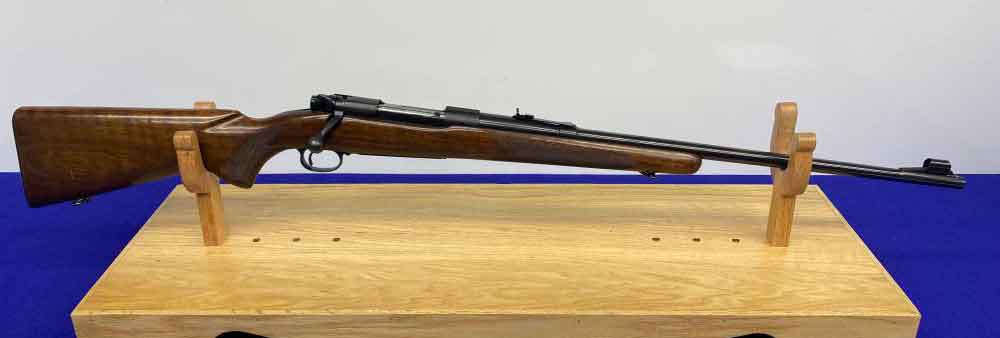
The example in the March Collection, bearing serial number 155913, was manufactured in 1950. This places it smack dab in the middle of the rifle’s most celebrated production era. 1950 was 14 years after the model was introduced and 14 years before the major changes took place. This was, truly, the Model 70’s golden era.
Chambered in .270 WCF, this particular rifle pairs one of America’s most enduring big game cartridges with a configuration that reflects Winchester’s mid-century sporting ideals. It has a 24-inch barrel, classic blued finish and a checkered walnut pistol grip stock shaped for both elegance and field practicality.
A Defining Engineering Standard
Introduced as a refinement of the earlier Model 54, the Model 70 quickly earned the nickname “The Rifleman’s Rifle.” The title was not marketing hyperbole. It reflected widespread admiration for the rifle’s smooth operation, intelligent design and dependable performance. And it did all this under the demanding conditions required by hunters and shooters.
At the heart of the pre-64 Winchester Model 70 is its controlled round feed system. That system was anchored by a full-length claw extractor that captured the cartridge rim as it rises from the magazine. This system ensures positive feeding and extraction. Those qualities were especially prized by hunters pursuing large or dangerous game in remote environments. The forged steel receiver and robust bolt construction further reinforce the rifle’s reputation for durability and longevity. Believe it or not, 90 years after the model was first introduced, there are still hundreds if not thousands of these original Winchester Model 70s still out in the field doing their job just as well as they did when they were brand new back in the 1930s.
The Model 70’s trigger design also contributed to its acclaim. With a notably clean break, it offered a level of refinement that helped the rifle deliver consistent, field-ready accuracy long before modern aftermarket systems became commonplace.
Classic Configuration and Field Versatility
In .270 WCF, the 1950 production rifle embodies one of the most iconic American hunting combinations of the 20th century. The cartridge’s flat trajectory and effective terminal performance made it a favorite for deer, antelope and elk, particularly in open Western terrain. Jack O’Connor, a renowned hunter and gun writer, extolled the model and caliber combination in a way that endures to this day. To many, the Model 70 and the .270 WCF are a match made in heaven. They were predestined to be together until the end of time. Paired with a 24-inch barrel, the combination delivers balanced handling and optimal ballistic performance.
This rifle even retains its traditional iron sight arrangement. This consists of a dovetail blade front with brass bead on a ramped base topped with a removable hood, combined with an elevator-adjustable rear sight with a folding leaf. The receiver is drilled and tapped to accommodate optics as well. This reflects the transitional era when scopes were becoming increasingly popular among American sportsmen.
The checkered walnut stock exemplifies Winchester’s commitment to both aesthetics and ergonomics in this golden era of gunsmithing. Hand-cut checkering, graceful lines and thoughtful proportions give the rifle a timeless profile while providing secure handling in the field. The deep blue finish complements the warm walnut tones, creating the visual harmony that defines classic American sporting arms.
Condition and Collector Significance
Condition is paramount when evaluating any pre-64 Model 70. This example is described as being in excellent overall condition, showing no visible evidence of regular consumer use or handling. For a rifle more than three-quarters of a century old, such preservation significantly enhances both its desirability and historical integrity.
Pre-64 rifles remain especially coveted because they represent the original manufacturing philosophy that many enthusiasts believe defined the Model 70’s identity. After 1964, production changes altered key design elements, making earlier examples distinct in both construction and collector perception.
An Enduring Benchmark
Now 90 years after its introduction, the Winchester Model 70 continues to serve as a standard against which other bolt-action rifles are measured. Yet within that broader legacy, the pre-64 examples hold a particularly elevated status. They symbolize a period when American firearms manufacturing emphasized forged components, meticulous fitting, and a balance of beauty and performance.
This 1950 Winchester Model 70 Standard in .270 WCF stands as a representative of that era. It is a physical embodiment of reliability, craftsmanship and understated elegance. For collectors and hunters alike, it remains not merely a rifle, but a benchmark of what a classic American sporting arm was meant to be.